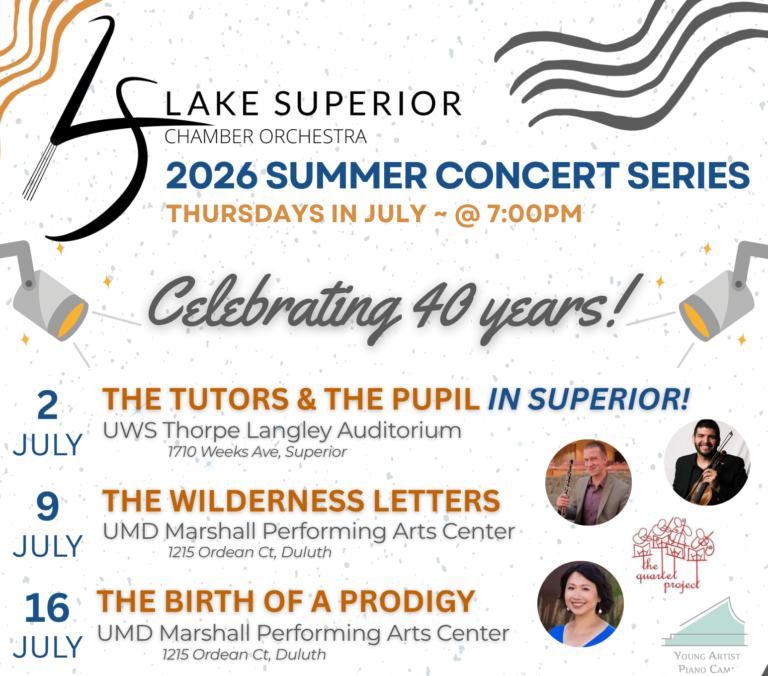
July 2 ~ UWS

The Tutors and the Pupil in Superior!

Thurs., July 2nd, @7:00PM
UWS Thorpe Langley Auditorium,
1710 Weeks Ave, Superior

Concert evenings begin at 6:00PM, lobby doors open.
Concert Hall & Seating Opens at 6:30PM.

James Zabawa-Martinez Plays Mozart

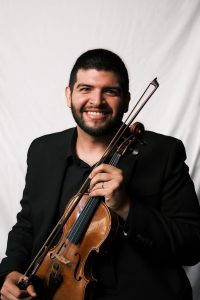
We welcome recording violinist James Zabawa-Martinez for our season welcome concert on July 2nd!

Program Notes

(Subject to Change: As of 6-13-26)

Johann Christian Bach (1735-1782) ….. Overture to Il tutore e la pupilla ….. 6′
     I. Allegro assai
     II. Andante
     III. Presto

Johann Christian Bach (1735–1782), known as the “London Bach,” was a vital bridge between the Baroque and Classical eras and a significant influence on the young Wolfgang Amadeus Mozart. His Overture to Il tutore e la pupilla (1762) marked his London debut. The work was written for a pasticcio—a popular, cost-effective theatrical production that recycled established “greatest hits” music with a new libretto to minimize financial risk.

Structured in the traditional Italian three-movement form (fast–slow–fast), the overture captures the galant style’s signature transparency and charm. Eschewing the complex counterpoint of his father’s generation, J.C. Bach focuses on rhythmic vitality, balanced phrasing, and effortless elegance. The vibrant outer movements flank a brief, tender central section, creating a polished, engaging curtain-raiser that perfectly anticipates the lighthearted, comedic operatic narrative to follow. This piece remains a delightful microcosm of the sophisticated, tuneful approach that brought Bach enduring international acclaim.

Wolfgang Amadeus Mozart (1756-1791) ….. Violin Concerto No. 4 in D major ….. 23’
     I. Allegro
     II. Andante catabile
     III. Rondeau. Andante grazioso

Many musicians (and their parents) can relate to this exchange between Leopold Mozart and his 21-year-old son, Wolfgang, in a letter from 1777. “Did you not practice the violin at all while you were in Munich? I dare say that would be really deplorable, particularly since Brunetti praised you to the skies!” Two weeks later, Mozart countered that his most recent solo performance “… went like oil [smoothly]. Everyone praised my beautiful, pure tone.” There are good reasons for the young Wolfgang to be confident in his violin. Afterall, he composed an exquisite set of five violin concertos when he was only 19 years old!

The Violin Concerto No. 4 in D Major mirrors the brilliance of the Mannheim orchestra, opening with a noble, fanfare-like rhythm that allows for dazzling solo arpeggios and runs. Mozart’s inherent operatic sensibility shines throughout the Andante cantabile. It unfolds with the expressive depth of an aria, balancing romantic longing with subtle harmonic tension. The finale, a rustic Rondeau, balances dance-like themes with a folk-inspired episode. Here, the soloist utilizes a “droning” effect on the lowest string, mimicking a hand-cranked hurdy-gurdy before the music softly fades into the night. Blending virtuoso athleticism with graceful wit, this concerto remains a masterpiece that captures the vibrant, expressive spirit of Mozart’s early creative life.

James Zabawa-Martinez, violin

A native of Austin, Texas, violinist James Zabawa-Martinez has performed concerts and recitals throughout the US and Europe. Before recently joining the First Violin section of Rochester Philharmonic Orchestra in 2024, James was a member of the Second Violin section of the Kansas City Symphony and also served as a violin fellow at the New World Symphony for two seasons, where he performed frequently as Concertmaster under the baton of Michael Tilson Thomas. James has performed with orchestras such as The Cleveland Orchestra, Minnesota Orchestra, Utah Symphony, and the Indianapolis Symphony Orchestra.

Beyond the stage, Zabawa-Martinez is a dedicated teacher, serving on the faculty at the Ithaca College School of Music, Theatre, and Dance. His expertise has been highlighted in media, notably appearing in the PBS Great Performances series episode Chasing Crescendos, where he shared insights into his life as a musician, practice methodology, and approaches to performing. His primary teachers include Sally O’Reilly, Brian Lewis, and Zoya Leybin.

Franz Joseph Haydn (1732-1809) ….. Symphony No. 45 “Farewell” in F-sharp minor ….. 26’

     I. Allegro assai
     II. Adagio
     III.
Minuet. Allegretto – Trio
     IV.
Finale. Presto – Adagio

In 1772, Joseph Haydn and his orchestra were stationed at Prince Nikolaus Esterházy’s remote Hungarian castle for an unusually long season. Exhausted and longing for their families in Vienna, the musicians were disheartened when the Prince requested they extend their stay to perform a new symphony. Sympathetic to their plight, Haydn devised a brilliant, musical protest. He composed his Symphony No. 45, now famously known as the “Farewell” Symphony, and orchestrated a unique finale. As the final movement reached its expected conclusion, an unexpected Adagio began. During this slower section, musician after musician finished their parts, extinguished their candles, and quietly exited the stage. By the end of the performance, only two violins remained.

The subtle message was clear. The Prince understood the protest and granted the musicians their leave the following day, allowing them to finally return home. This clever integration of performance art and diplomatic negotiation solidified the symphony’s legacy, remaining one of the most famous and touching stories in classical music history. 

Beyond its programmatic ingenuity, the work is a masterpiece of the Classical era. The intense first movement is marked by nervous energy and striking dissonance. It is followed by a deeply expressive, warmly colored Adagio and a graceful, sophisticated Minuet. The finale’s transition from high-energy “whiplash” to the poignant, thinning departure of the orchestra showcases Haydn’s ability to summon profound emotional depth, making this symphony an enduringly original and affecting testament to the power of music.