Concert evenings begin at 6:00PM, lobby doors open.
Concert Hall & Seating Opens at 6:30PM.
This activity is made possible in part by a grant from the Arrowhead Regional Arts Council with funds appropriated by the Minnesota State Legislature from its General Fund.
Conductor ($1,000+)
~
Guest Artists ($500+)
~
Musician Chairs ($250+)
~
Benefactors ($100-249)
~
Friends ($1-99)
~
The season will feature guest artists who have strong connections with our state of Minnesota. New York-based recording violinist James Zabawa-Martinez will return to present us with Mozart’s delightful Violin Concerto No. 4, University of Minnesota Duluth professor, Brett Linski, will perform the world premiere of Mark Buller’s Letters from the Wilderness, and touring soprano Jennifer Lien, will sing the world premiere performance of the newly orchestrated version of Melissa Dunphy’s Chinoiserie. Along with the two world premieres, we are also presenting two other Minnesota premieres by British composer Ruth Gipps and Michigan-based composer Gala Flagello.
I am thrilled to welcome Dr. Jennifer Fagre-Golya to lead The Quartet Project, a cornerstone of our education program this summer. Like our other years, the students will receive expert coaching from LSCO members for two weeks. The accumulation of their efforts will be showcased in the quartet recital and the side-by-side concert with the LSCO on July 9, performing Vaughan William’s monumental Fantasia on a Theme by Thomas Tallis. Also important to our educational mission is the collaboration with the Young Artist Piano Camp. This year’s winners of the concerto competition will join the orchestra as soloists of the Season Finale on July 16 on Mozart’s spirited Piano Concerto No. 17.
Your support of the LSCO fuels our vision. We are honored to have contributed to the cultural fabric of the Twin Ports community for the last 40 years. With your support, we hope to sustain that mission and continue to expand the artistic boundaries for many more years to come.
~ Ho-Yin Kwok
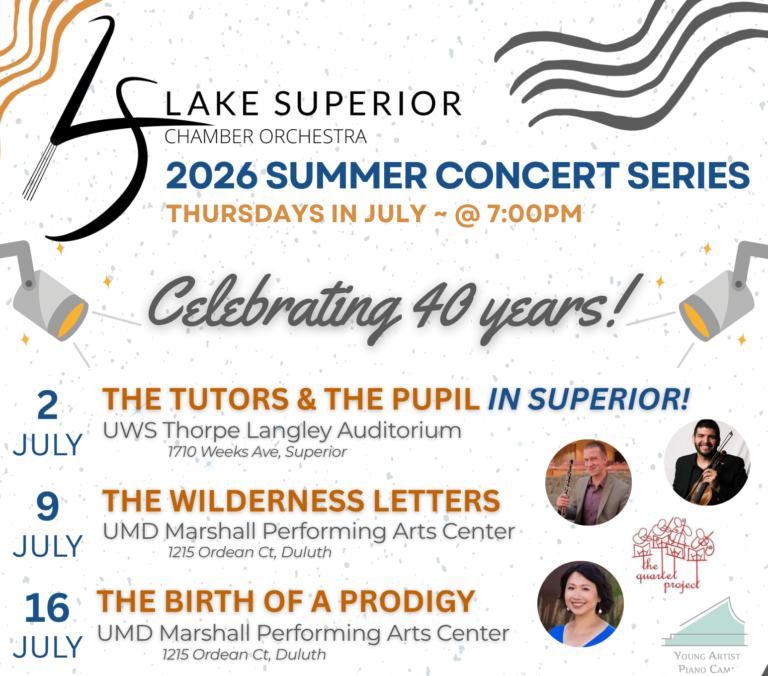
We welcome recording violinist James Zabawa-Martinez for our season welcome concert on July 2nd!
Johann Christian Bach (1735-1782) ….. Overture to Il tutore e la pupilla ….. 6′
I. Allegro assai
II. Andante
III. Presto
Johann Christian Bach (1735–1782), known as the “London Bach,” was a vital bridge between the Baroque and Classical eras and a significant influence on the young Wolfgang Amadeus Mozart. His Overture to Il tutore e la pupilla (1762) marked his London debut. The work was written for a pasticcio—a popular, cost-effective theatrical production that recycled established “greatest hits” music with a new libretto to minimize financial risk.
Structured in the traditional Italian three-movement form (fast–slow–fast), the overture captures the galant style’s signature transparency and charm. Eschewing the complex counterpoint of his father’s generation, J.C. Bach focuses on rhythmic vitality, balanced phrasing, and effortless elegance. The vibrant outer movements flank a brief, tender central section, creating a polished, engaging curtain-raiser that perfectly anticipates the lighthearted, comedic operatic narrative to follow. This piece remains a delightful microcosm of the sophisticated, tuneful approach that brought Bach enduring international acclaim.
Wolfgang Amadeus Mozart (1756-1791) ….. Violin Concerto No. 4 in D major ….. 23’
I. Allegro
II. Andante catabile
III. Rondeau. Andante grazioso
– James Zabawa-Martinez, violin
Many musicians (and their parents) can relate to this exchange between Leopold Mozart and his 21-year-old son, Wolfgang, in a letter from 1777. “Did you not practice the violin at all while you were in Munich? I dare say that would be really deplorable, particularly since Brunetti praised you to the skies!” Two weeks later, Mozart countered that his most recent solo performance “… went like oil [smoothly]. Everyone praised my beautiful, pure tone.” There are good reasons for the young Wolfgang to be confident in his violin. Afterall, he composed an exquisite set of five violin concertos when he was only 19 years old!
The Violin Concerto No. 4 in D Major mirrors the brilliance of the Mannheim orchestra, opening with a noble, fanfare-like rhythm that allows for dazzling solo arpeggios and runs. Mozart’s inherent operatic sensibility shines throughout the Andante cantabile. It unfolds with the expressive depth of an aria, balancing romantic longing with subtle harmonic tension. The finale, a rustic Rondeau, balances dance-like themes with a folk-inspired episode. Here, the soloist utilizes a “droning” effect on the lowest string, mimicking a hand-cranked hurdy-gurdy before the music softly fades into the night. Blending virtuoso athleticism with graceful wit, this concerto remains a masterpiece that captures the vibrant, expressive spirit of Mozart’s early creative life.
Franz Joseph Haydn (1732-1809) ….. Symphony No. 45 “Farewell” in F-sharp minor ….. 26’
I. Allegro assai
II. Adagio
III. Minuet. Allegretto – Trio
IV. Finale. Presto – Adagio
In 1772, Joseph Haydn and his orchestra were stationed at Prince Nikolaus Esterházy’s remote Hungarian castle for an unusually long season. Exhausted and longing for their families in Vienna, the musicians were disheartened when the Prince requested they extend their stay to perform a new symphony. Sympathetic to their plight, Haydn devised a brilliant, musical protest. He composed his Symphony No. 45, now famously known as the “Farewell” Symphony, and orchestrated a unique finale. As the final movement reached its expected conclusion, an unexpected Adagio began. During this slower section, musician after musician finished their parts, extinguished their candles, and quietly exited the stage. By the end of the performance, only two violins remained.
The subtle message was clear. The Prince understood the protest and granted the musicians their leave the following day, allowing them to finally return home. This clever integration of performance art and diplomatic negotiation solidified the symphony’s legacy, remaining one of the most famous and touching stories in classical music history.
Beyond its programmatic ingenuity, the work is a masterpiece of the Classical era. The intense first movement is marked by nervous energy and striking dissonance. It is followed by a deeply expressive, warmly colored Adagio and a graceful, sophisticated Minuet. The finale’s transition from high-energy “whiplash” to the poignant, thinning departure of the orchestra showcases Haydn’s ability to summon profound emotional depth, making this symphony an enduringly original and affecting testament to the power of music.
James Zabawa-Martinez, violin
A native of Austin, Texas, violinist James Zabawa-Martinez has performed concerts and recitals throughout the US and Europe. Before recently joining the First Violin section of Rochester Philharmonic Orchestra in 2024, James was a member of the Second Violin section of the Kansas City Symphony and also served as a violin fellow at the New World Symphony for two seasons, where he performed frequently as Concertmaster under the baton of Michael Tilson Thomas. James has performed with orchestras such as The Cleveland Orchestra, Minnesota Orchestra, Utah Symphony, and the Indianapolis Symphony Orchestra.
Beyond the stage, Zabawa-Martinez is a dedicated teacher, serving on the faculty at the Ithaca College School of Music, Theatre, and Dance. His expertise has been highlighted in media, notably appearing in the PBS Great Performances series episode Chasing Crescendos, where he shared insights into his life as a musician, practice methodology, and approaches to performing. His primary teachers include Sally O’Reilly, Brian Lewis, and Zoya Leybin.
We welcome Brett Linski, Professor at UMD and oboist, as well as look forward a world premiere and two Minnesota premieres this evening!
The Quartet Project will also appear with the LSCO to perform their side-by-side piece during the concert.
Ruth Gipps (1921-1999) ….. Cringlemire Garden (Minnesota Premiere) ….. 7’
Ruth Gipps was a trailblazing British composer, conductor, and oboist whose prolific output was marked by a mastery of traditional forms and a distinctively lush, Romantic harmonic language. Composed in 1955, Cringlemire Garden is a charming and evocative tone poem that draws its inspiration from the English landscape—specifically, the garden of her home in the Lake District.
The work is a vibrant exercise in orchestral color and atmospheric writing. Rather than a literal depiction, Gipps captures the spirit of the garden through sweeping, lyrical melodies at the beginning of the piece and transitions to the playful middle section. The piece concludes with the recapitulation of the opening theme in a grand orchestration that reminds the listener of the music of her mentor, Ralph Vaughan Williams. Cringlemire Garden serves as a poignant reminder of Gipps’ ability to weave deep emotional sincerity with a quintessentially British sense of pastoral elegance and structural refinement.
Gala Flagello (b. 1994) ….. Droughts and Downpours (Minnesota Premiere) ….. 8’
Gala Flagello’s Droughts and Downpours was originally written as a double bass septet as a musical exploration of climate instability, translated through a vivid, percussive musical language. Inspired by the increasingly erratic weather patterns characterizing our current era, the work mirrors the tension between long, arid stillness and the sudden, overwhelming intensity of torrential rain.
Flagello utilizes a jagged, energetic rhythmic palette to capture this volatility. The music frequently shifts between periods of stark, minimalist tension—representing the “drought”—and dense, rapid-fire textures that evoke the chaotic force of a “downpour.” Rather than a mere imitation of nature, the piece acts as a psychological response to environmental unpredictability, balancing a sense of anxiety with moments of fragile beauty. The version for string orchestra was co-commissioned by Elias Miller and the Apollo Ensemble of Boston, ROCO Chamber Orchestra, and Ho-Yin Kwok and Ithaca College.
Mark Buller (b. 1986) ….. Letters from the Wilderness (World Premiere) ….. 12’
Coming soon…
Brett Linski, English Horn
Dr. Brett Linski is an Assistant Professor of Music History and Oboe at the University of Minnesota Duluth. A dedicated educator and performer, he encourages students to find their unique voices as artists and teachers. Dr. Linski holds a Doctor of Musical Arts from the University of Houston and a Bachelor of Music from UMD.
An active performer on oboe and English horn, he has appeared with the Duluth-Superior and Houston Symphony Orchestras, among others, and is featured on the album So the Night Fall. His scholarly work includes lecturing on music history and presenting on cadenza composition for the International Double Reed Society. Outside of the classroom, Dr. Linski is an author and illustrator. His upcoming projects include his book, Oboes Don’t Polka: A Teaching Guide for Non-Oboists, and a performance of Letters from the Wilderness, an English horn concerto he commissioned from composer Mark Buller.
Edward Elgar (1857-1934) ….. Sospiri ….. 5’
Elgar provisionally called this short work Soupir d’Amour, intending it as a companion piece to Salut d’Amour, a light popular work for the masses. What emerged, however, was a work of considerably greater substance. He composed it in the months leading up to the outbreak of the First World War and it was perhaps the gathering stormclouds of war that moved him to write a heartfelt, bleak adagio that would not be out of place as the slow movement of an Elgar symphony.
The dedicatee, W H (Billy) Reed was the leader of the London Symphony Orchestra. He became a close personal friend of Elgar. Although Elgar was himself a violinist of some ability, he frequently turned to Reed for advice on technical issues when composing works such as the Violin Sonata. After Elgar’s death, Reed was encouraged by George Bernard Shaw to record his memories of Elgar in the book Elgar as I knew him.
Ralph Vaughn Williams (1872-1958) ….. Fantasia on a Theme by Thomas Tallis ….. 18’
Ralph Vaughn Williams’ Fantasia on a Theme by Thomas Tallis (1910) is a masterpiece of 20th-century English music. Inspired by the Renaissance practice of borrowing and reimagining existing themes, Vaughan Williams drew upon a 16th-century hymn tune by Thomas Tallis. The composer first encountered this haunting Phrygian-mode melody while editing the English Hymnal and later expanded it into a richly textured work for double string orchestra and a solo string quartet.
The piece opens with an introduction followed by two complete statements of the theme, where the music rises to high, shimmering violin textures. Vaughan Williams then masterfully divides his forces, creating a musical conversation where the orchestras echo one another and soloists—particularly the viola and violin—develop thematic fragments. This intricate dialogue eventually culminates in a return of the complete theme, supported by the full ensemble.
Notable for its diaphanous modal harmonies and expansive, glowing string textures, the Fantasia serves as a modern reimagining of the Renaissance instrumental tradition. It remains a deeply spiritual meditation, bridging the divide between the 16th-century Tudor era and the evocative, pastoral soundscape of the 20th century.
The night kicks off with a world premiere of LSCO-commissioned Chinoiserie by internationally renowned composer Melissa Dunphy, with touring soprano Jennifer Lien!
The Young Artist Piano Camp is again collaborating with the LSCO for our July 16th concert. The winner(s) of the Piano Camp concerto competition will perform their winning performance piece with the LSCO.
Melissa Dunphy (b. 1980) ….. Chinoiserie (LSCO Co-commissioned World Premiere) ….. 15’
I. Willow Pattern
II. Spilling Truth
III. Counterfeit
– Jennifer Lien, soprano
“As someone raised by Chinese parents in a Western country, I have often felt like an imposter in both Asian and Western contexts as I continually grapple with which culture I can call my own. Perhaps because of this, I am fascinated by the art and design that arises from interactions between East and West. Many European artistic styles that explicitly mimic Chinese art have evolved into signifiers of non-Chinese national identities, while since the late 20th century, ironically, Chinese manufacturers have developed a reputation for mass production of inferior copies of European luxuries. The questions of authenticity and ownership that surround these art forms—including music—feel especially relevant to my experience as an Asian-American composer. Chinoiserie explores these issues through songs about the British Blue Willow china pattern, the destruction of the Old Summer Palace in Beijing, and my own tangled reactions of pride, regret, and self-reflection when delving into the complicated, distorted mirror of Eastern culture in Western art.” – Melissa Dunphy
Chinoiserie was co-commissioned by soprano Jennifer Lien and Cincinnati Song Initiative in 2024, with the help of generous funding from the Minnesota State Arts Board. Tonight marks the world premiere of the chamber orchestra arrangement of this song cycle, co-commissioned by Lake Superior Chamber Orchestra and Ithaca College.
[Note: It is generally agreed that the legend of the willow pattern was an exotic invention by British ceramicists, who imitated the motifs from Chinese porcelain.]
Wolfgang Amadeus Mozart ….. Piano Concerto No. 17 in G major, K. 453 ….. 17′
I. Allegro
II. Andante
III. Allegretto – Presto
– Soloist – Piano Camp Concerto Competition winner(s)
Wolfgang Amadeus Mozart’s Piano Concerto No. 17 in G Major, K. 453 (1784) was composed for his talented student, Barbara Ployer, and premiered at her uncle’s home in June of that year. The work stands as a hallmark of Mozart’s maturity, particularly in its sophisticated and independent treatment of the woodwind section—a significant departure from the wind-light textures of his earlier Salzburg concertos.
The second movement is especially dramatic, featuring a serene string theme that is repeatedly interrupted by striking, operatic pauses. These structural breaks, where the strings cede the spotlight to the flute, oboe, and bassoon, create a level of tension and dialogue rarely seen in the concertos of his contemporaries. The finale further showcases Mozart’s formal ingenuity; rather than a conventional rondo, he presents five variations on a theme—a melody famously associated with a pet starling Mozart acquired in 1784. Whether the bird inspired the theme or merely mimicked it remains a subject of playful historical debate. This concerto remains a brilliant example of Mozart’s endless creativity and imaginations.
Wolfgang Amadeus Mozart ….. Symphony No. 41 “Jupiter” in C major, K. 551 ….. 30′
I. Allegro Allegro vivace
II. Andante Andante cantabile
III. Menuetto: Allegretto – Trio
IV. Molto allegro
Wolfgang Amadeus Mozart’s final symphony, the “Jupiter” (K. 551), was completed in August 1788 during a period of immense personal struggle. Despite faltering finances and personal tragedy, this year proved remarkably productive, yielding his final trilogy of symphonies in less than two months. The nickname “Jupiter,” likely bestowed posthumously by impresario Johann Peter Salomon, reflects the work’s grandeur and weighty character.
From its opening—defined by powerful C-major strokes contrasted with gentle “sighing” figures—the symphony asserts a unique authority. Following an expressive andante cantabile and an elegant Menuetto, the work reaches its zenith in the famous finale. Long celebrated as “the symphony with the fugal ending,” this movement is a marvel of technical mastery. Mozart weaves five distinct themes into a sophisticated web of fugue and canon, culminating in a dazzling coda where all motives sound simultaneously. Unlike the lighthearted finales typical of the era, this movement provides a serious, climactic conclusion. Its profound weight and intellectual ambition ensured its status as a revered masterwork of the nineteenth century, standing proudly alongside the symphonies of Beethoven.
Jennifer Lien, soprano
Soprano Jennifer Lien has been seen on opera and concert stages in California, Florida, Illinois, New York, New Hampshire, North Carolina, Minnesota, Wisconsin, and Singapore. Most recently, Lien was seen in A Little Night Music with Lyric Opera of the North. Coming up is the final performance in Michigan of her two-year tour of mOthertongue, a recital of three commissioned song cycles from Asian American women composers. Lien is a 2024 Minnesota State Arts Board grantee. She is also a co-founder of the Twin Ports APIDA Collective. Lien holds degrees from Dartmouth College, San José State University, and the University of Wisconsin-Madison. She currently teaches voice at The College of St. Scholastica in Duluth, MN. https://www.jenniferliensoprano.com/