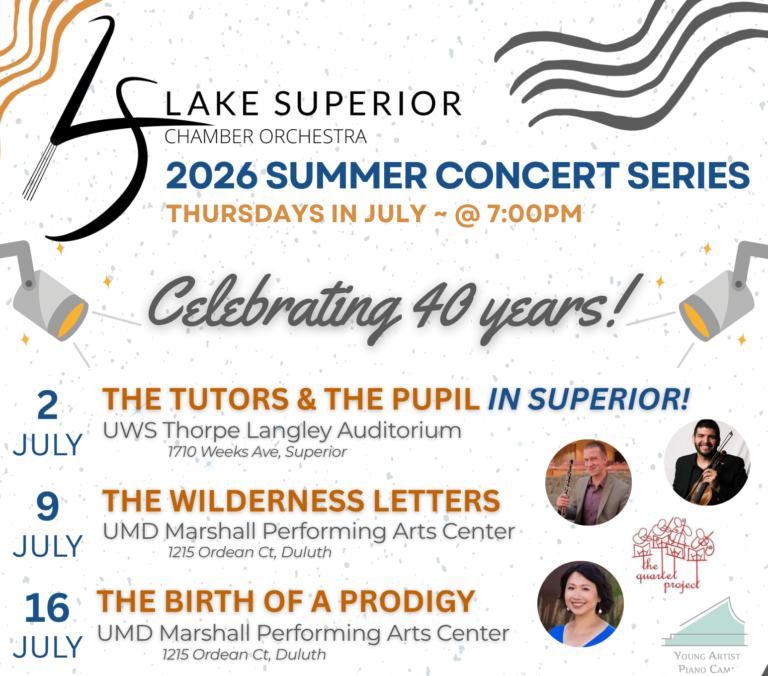
July 16 ~ UMD

The Birth of a Prodigy

Thurs., July 16th, @7:00PM
UMD Marshall Performing Arts Center, 1215 Ordean Ct, Duluth

Concert evenings begin at 6:00PM, lobby doors open. 
Concert Hall & Seating Opens at 6:30PM.

World Premiere of Chinoiserie with Jennifer Lien, & Piano Camp Concerto Competition Winner

The night kicks off with a world premiere of LSCO-commissioned Chinoiserie by internationally renowned composer Melissa Dunphy, with touring soprano Jennifer Lien!

The Young Artist Piano Camp is again collaborating with the LSCO for our July 16th concert. The winner(s) of the Piano Camp concerto competition will perform their winning performance piece with the LSCO.

Program Notes

(Subject to Change: As of 6-13-26)

Melissa Dunphy (b. 1980) ….. Chinoiserie (LSCO Co-commissioned World Premiere) ….. 15’

     I. Willow Pattern
     II. Spilling Truth
     III. Counterfeit

“As someone raised by Chinese parents in a Western country, I have often felt like an imposter in both Asian and Western contexts as I continually grapple with which culture I can call my own. Perhaps because of this, I am fascinated by the art and design that arises from interactions between East and West. Many European artistic styles that explicitly mimic Chinese art have evolved into signifiers of non-Chinese national identities, while since the late 20th century, ironically, Chinese manufacturers have developed a reputation for mass production of inferior copies of European luxuries. The questions of authenticity and ownership that surround these art forms—including music—feel especially relevant to my experience as an Asian-American composer. Chinoiserie explores these issues through songs about the British Blue Willow china pattern, the destruction of the Old Summer Palace in Beijing, and my own tangled reactions of pride, regret, and self-reflection when delving into the complicated, distorted mirror of Eastern culture in Western art.” – Melissa Dunphy

Chinoiserie was co-commissioned by soprano Jennifer Lien and Cincinnati Song Initiative in 2024, with the help of generous funding from the Minnesota State Arts Board. Tonight marks the world premiere of the chamber orchestra arrangement of this song cycle, co-commissioned by Lake Superior Chamber Orchestra and Ithaca College.

[Note: It is generally agreed that the legend of the willow pattern was an exotic invention by British ceramicists, who imitated the motifs from Chinese porcelain.]

Lyrics:

I. Willow Pattern
“Gather thy blossom, ere it be stolen”

Far away within the East,
a monarch kept his state,
and near him, just across the bridge,
there lived a prince (see plate).

The monarch had a daughter fair.
The prince in love was he.
“No, no, good man,” the monarch said,
“My daughter stays with me.”

But to her lover, she wrote:
“Gather thy blossom, ere it be stolen…”

Across the bridge the lovers fled.
The king pursued irate.
They hied them to a little boat
and sailed away (see plate).

Alas the stormy winds did blow,
as cruel as cruel could be.
They dashed the boat upon the rocks,
and drowned them in the sea.

But changed to birds by fairies kind,
their spirits rose elate.
And even now about the king,
they hover still (see plate).

Two birds flying high,
a Chinese vessel sailing by,
a bridge with three men, sometimes four,
a willow tree hanging o’er,
a Chinese temple, there it stands,
built upon the river sands,
an apple tree with apples on,
a crooked fence to end my song.

“Gather thy blossom, ere it be stolen.”

II. Spilling Truth

I drink my mother’s favorite tea
in a china cup of exquisite whiteness.

Since you want my opinion, here it is:
There was, in a corner of the world,
a wonder called the Summer Palace.
Build a dream with marble, jade, bronze, porcelain,
frame it in cedar,
cover it with precious stones,
drape it with silk,
varnish it, enamel it, gild it, paint it,
add gardens, pools, gushes of water and foam,
swans, ibises, peacocks,
imagine a dazzling cavern of fantasy—
that was the Summer Palace.
The slow work of two generations built this monument.
For whom? For the people.
Artists, poets, and philosophers knew it.
They said: the Parthenon in Greece,
the Pyramids in Egypt,
the Colosseum in Rome,
Notre-Dame in Paris,
the Summer Palace in the Orient.
If one did not see it, one dreamed of it,
a frightening unknown masterpiece
glimpsed in the distance in some unknown twilight.
One day, two bandits arrived.
One plundered, the other burned.
More efficient than Elgin,
they left nothing behind.
One filled his pockets,
while the other filled his coffers;
and they returned home with their spoils,
arm in arm, laughing.

A dog snatched from the Summer Palace
was given to Queen Victoria,
who named her Looty.
Shattered lines of crazing on a porcelain cup.
The tea burns my lips.
My mother’s favorite tea is called Tiegoonyum,
named after the Goddess of Mercy. 

III. Counterfeit
Expensive silk brocades traveled through Syria
to become the opulent robes of priests—
Italian luxury fashion, made in China!

Porcelain’s secret formula evaded Europe’s alchemists,
so potters from Delft made do,
painting alien landscapes in cobalt blue—
strange, improbable temples, grotesque foliage,
and mountains like camel humps—
on soft clay glazed in white tin.
Now their work is kneaded into their nation’s soul.

In Paris, a Tang Dynasty pipa,
once gifted between emperors,
captivated Georges Vuitton.
He added his father’s monogram to its inlaid geometry
and printed the pattern on canvas to carry imperial baggage.

Fast forward to fast fashion:
Copies of Valentino and Vuitton
pour out of sweatshop factories.
Blue and white toile—cotton dressed as clay—
adorned with peonies and crested birds.
Anything your heart desires, you can own, all made in China!
Even my own grandfather warned me not to buy.

My mother sang Chinese songs when I was in her belly.
I never learned her mother tongue,
but in my own voice, I can sing Puccini…

…yòu xiāng yòu bái rén rén kua
 

In questa reggia,
or son mill’anni e mille,
un grido disperato risonò.
E quel grido, traverso stirpe e stirpe

qui nell’anima mia si rifugiò!

Principessa Lo-u-Ling,
ava dolce e serena
che regnavi nel tuo cupo silenzio
in gioia pura,
e sfidasti inflessibile e sicura
l’aspro dominio,
oggi rivivi in me! 

Within this Palace
a story lives forever.
A cry of anguish rang out years ago,
cry of anguish that travelled through the ages,
cries that darkened and froze my inmost soul!
Gentle Princess Lo-u-Ling,
pure, serene and so gentle,
she who reigned here in seclusion,
so peaceful and in silence,
meeting firmly and proudly ev’ry vile and
insolent onslaught,
you are alive in me!

Jennifer Lien, soprano

Soprano Jennifer Lien has been seen on opera and concert stages in California, Florida, Illinois, New York, New Hampshire, North Carolina, Minnesota, Wisconsin, and Singapore. Most recently, Lien was seen in A Little Night Music with Lyric Opera of the North. Coming up is the final performance in Michigan of her two-year tour of mOthertongue, a recital of three commissioned song cycles from Asian American women composers. Lien is a 2024 Minnesota State Arts Board grantee. She is also a co-founder of the Twin Ports APIDA Collective. Lien holds degrees from Dartmouth College, San José State University, and the University of Wisconsin-Madison. She currently teaches voice at The College of St. Scholastica in Duluth, MN. https://www.jenniferliensoprano.com/

Wolfgang Amadeus Mozart ….. Piano Concerto No. 17 in G major, K. 453 ….. 17′

     I. Allegro
     II. Andante
     III. Allegretto – Presto

– Soloist – Piano Camp Concerto Competition winner(s)

Wolfgang Amadeus Mozart’s Piano Concerto No. 17 in G Major, K. 453 (1784) was composed for his talented student, Barbara Ployer, and premiered at her uncle’s home in June of that year. The work stands as a hallmark of Mozart’s maturity, particularly in its sophisticated and independent treatment of the woodwind section—a significant departure from the wind-light textures of his earlier Salzburg concertos.

The second movement is especially dramatic, featuring a serene string theme that is repeatedly interrupted by striking, operatic pauses. These structural breaks, where the strings cede the spotlight to the flute, oboe, and bassoon, create a level of tension and dialogue rarely seen in the concertos of his contemporaries. The finale further showcases Mozart’s formal ingenuity; rather than a conventional rondo, he presents five variations on a theme—a melody famously associated with a pet starling Mozart acquired in 1784. Whether the bird inspired the theme or merely mimicked it remains a subject of playful historical debate. This concerto remains a brilliant example of Mozart’s endless creativity and imaginations.

Wolfgang Amadeus Mozart ….. Symphony No. 41 “Jupiter” in C major, K. 551 ….. 30′

     I. Allegro Allegro vivace
     II. Andante Andante cantabile
     III. Menuetto: Allegretto – Trio
     IV. Molto allegro

Wolfgang Amadeus Mozart’s final symphony, the “Jupiter” (K. 551), was completed in August 1788 during a period of immense personal struggle. Despite faltering finances and personal tragedy, this year proved remarkably productive, yielding his final trilogy of symphonies in less than two months. The nickname “Jupiter,” likely bestowed posthumously by impresario Johann Peter Salomon, reflects the work’s grandeur and weighty character.

From its opening—defined by powerful C-major strokes contrasted with gentle “sighing” figures—the symphony asserts a unique authority. Following an expressive andante cantabile and an elegant Menuetto, the work reaches its zenith in the famous finale. Long celebrated as “the symphony with the fugal ending,” this movement is a marvel of technical mastery. Mozart weaves five distinct themes into a sophisticated web of fugue and canon, culminating in a dazzling coda where all motives sound simultaneously. Unlike the lighthearted finales typical of the era, this movement provides a serious, climactic conclusion. Its profound weight and intellectual ambition ensured its status as a revered masterwork of the nineteenth century, standing proudly alongside the symphonies of Beethoven.