July 9 ~ UMD

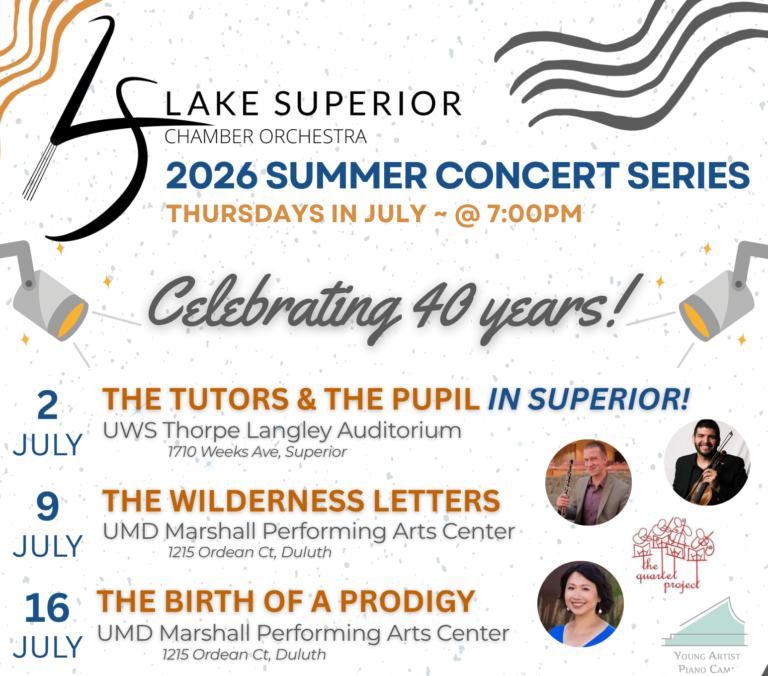
The Wilderness Letters

Thurs., July 9th, @7:00PM
UMD Marshall Performing Arts Center, 1215 Ordean Ct, Duluth
Concert evenings begin at 6:00PM, lobby doors open. 

Concert Hall & Seating Opens at 6:30PM.

The Quartet Project &
Premieres, with Brett Linski

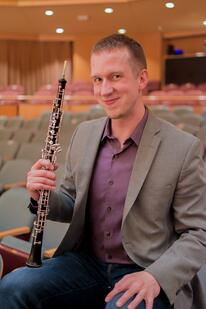
We welcome Brett Linski, Professor at UMD and oboist, as well as look forward a world premiere and two Minnesota premieres this evening! The Quartet Project will also appear with the LSCO to perform their side-by-side piece during the concert. 

Program Notes

(Subject to Change: As of 6-13-26)

Ruth Gipps (1921-1999) ….. Cringlemire Garden (Minnesota Premiere) ….. 7’

Ruth Gipps was a trailblazing British composer, conductor, and oboist whose prolific output was marked by a mastery of traditional forms and a distinctively lush, Romantic harmonic language. Composed in 1955, Cringlemire Garden is a charming and evocative tone poem that draws its inspiration from the English landscape—specifically, the garden of her home in the Lake District.

The work is a vibrant exercise in orchestral color and atmospheric writing. Rather than a literal depiction, Gipps captures the spirit of the garden through sweeping, lyrical melodies at the beginning of the piece and transitions to the playful middle section. The piece concludes with the recapitulation of the opening theme in a grand orchestration that reminds the listener of the music of her mentor, Ralph Vaughan Williams. Cringlemire Garden serves as a poignant reminder of Gipps’ ability to weave deep emotional sincerity with a quintessentially British sense of pastoral elegance and structural refinement.

Gala Flagello (b. 1994) ….. Droughts and Downpours (Minnesota Premiere) ….. 8’

Gala Flagello’s Droughts and Downpours was originally written as a double bass septet as a musical exploration of climate instability, translated through a vivid, percussive musical language. Inspired by the increasingly erratic weather patterns characterizing our current era, the work mirrors the tension between long, arid stillness and the sudden, overwhelming intensity of torrential rain.

Flagello utilizes a jagged, energetic rhythmic palette to capture this volatility. The music frequently shifts between periods of stark, minimalist tension—representing the “drought”—and dense, rapid-fire textures that evoke the chaotic force of a “downpour.” Rather than a mere imitation of nature, the piece acts as a psychological response to environmental unpredictability, balancing a sense of anxiety with moments of fragile beauty. The version for string orchestra was co-commissioned by Elias Miller and the Apollo Ensemble of Boston, ROCO Chamber Orchestra, and Ho-Yin Kwok and Ithaca College.

Mark Buller (b. 1986) ….. Letters from the Wilderness (World Premiere) ….. 12’

Letters from the Wilderness was commissioned by my friend Brett Linski, a classmate from our doctoral work at the University of Houston. Brett was the oboe soloist in a large-scale oratorio I wrote, and the moment I heard him play his first notes I knew I had to write for him further. I was so pleased a few years later to be able to write this concerto for Brett – and fortunately it wouldn’t be our last collaboration either, as Brett later commissioned a sonata for oboe and piano, ‘Nocturne and Fantasia,’ which he premiered in 2024.

This concerto provided an opportunity for me to explore the rich, dark timbre of the English horn, certainly, but also to play the instrument against type and make it dance in its bright, colorful upper register. I wrote the piece largely during a two-week artist residency at AIR Serenbe in 2018, where I was able to hide away in a cabin in the Chattahoochee Hills of Georgia. During my time there I took frequent walks through the dark woods, in between bouts of driving rain and storms. This experience led to the title: Letters from the Wilderness, a musical missive to my longtime friend.

Brett Linski, English Horn

Dr. Brett Linski is an Assistant Professor of Music History and Oboe at the University of Minnesota Duluth. A dedicated educator and performer, he encourages students to find their unique voices as artists and teachers. Dr. Linski holds a Doctor of Musical Arts from the University of Houston and a Bachelor of Music from UMD.

An active performer on oboe and English horn, he has appeared with the Duluth-Superior and Houston Symphony Orchestras, among others, and is featured on the album So the Night Fall. His scholarly work includes lecturing on music history and presenting on cadenza composition for the International Double Reed Society. Outside of the classroom, Dr. Linski is an author and illustrator. His upcoming projects include his book, Oboes Don’t Polka: A Teaching Guide for Non-Oboists, and a performance of Letters from the Wilderness, an English horn concerto he commissioned from composer Mark Buller.

Intermission
Quartet Project Logo
The Quartet Project Side-by-Side

Edward Elgar (1857-1934) ….. Sospiri ….. 5’

Elgar provisionally called this short work Soupir d’Amour, intending it as a companion piece to Salut d’Amour, a light popular work for the masses. What emerged, however, was a work of considerably greater substance. He composed it in the months leading up to the outbreak of the First World War and it was perhaps the gathering stormclouds of war that moved him to write a heartfelt, bleak adagio that would not be out of place as the slow movement of an Elgar symphony. 

The dedicatee, W H (Billy) Reed was the leader of the London Symphony Orchestra. He became a close personal friend of Elgar. Although Elgar was himself a violinist of some ability, he frequently turned to Reed for advice on technical issues when composing works such as the Violin Sonata. After Elgar’s death, Reed was encouraged by George Bernard Shaw to record his memories of Elgar in the book Elgar as I knew him.

Ralph Vaughn Williams (1872-1958) ….. Fantasia on a Theme by Thomas Tallis ….. 18’

Ralph Vaughn Williams’ Fantasia on a Theme by Thomas Tallis (1910) is a masterpiece of 20th-century English music. Inspired by the Renaissance practice of borrowing and reimagining existing themes, Vaughan Williams drew upon a 16th-century hymn tune by Thomas Tallis. The composer first encountered this haunting Phrygian-mode melody while editing the English Hymnal and later expanded it into a richly textured work for double string orchestra and a solo string quartet.

The piece opens with an introduction followed by two complete statements of the theme, where the music rises to high, shimmering violin textures. Vaughan Williams then masterfully divides his forces, creating a musical conversation where the orchestras echo one another and soloists—particularly the viola and violin—develop thematic fragments. This intricate dialogue eventually culminates in a return of the complete theme, supported by the full ensemble.

Notable for its diaphanous modal harmonies and expansive, glowing string textures, the Fantasia serves as a modern reimagining of the Renaissance instrumental tradition. It remains a deeply spiritual meditation, bridging the divide between the 16th-century Tudor era and the evocative, pastoral soundscape of the 20th century.